what kind of salt to use for sauerkraut

Homemade sauerkraut, all salty and sour, is brilliantly easy to make at dwelling house. All y'all need is two simple ingredients: cabbage and common salt. And then enough of time to allow naturally occurring beneficial bacteria to ferment the cabbage, producing a vibrantly complex and delicious nutrient.
Spring to Recipe | What is it? | Benefits | Tips | Storage | Fermentation | Crocks | Variations
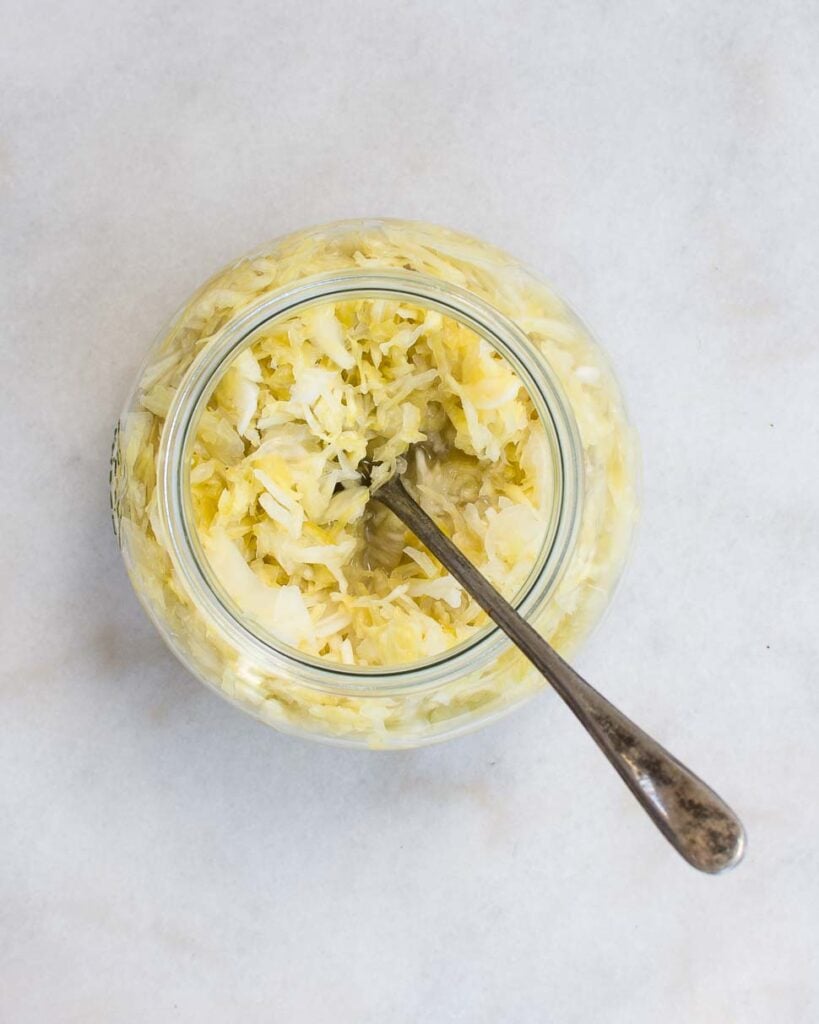
What is sauerkraut?
Sauerkraut is a traditional fermented food fabricated by allowing shredded cabbage and salt to ferment over a period of time. Afterward fermenting for a period of weeks or months, it produces a stiff sour side dish that is rich in beneficial bacteria.
You'll find similar dishes made from fermented cabbage, like kimchi and curtido, throughout the world, sauerkraut has its roots in German and Eastern European cooking.
Like near fermented vegetables, information technology'southward easy to make at home and yous only need two very unproblematic and inexpensive ingredients: cabbage and salt.
Is it good for you?
Like all fermented foods, sauerkraut is rich in beneficial bacteria(i). Information technology is particularly rich in the same beneficial bacteria that you tin also notice in foods such as kefir, sour pickles, and yogurt. All of these foods are produced through a process of lacto-fermentation, which encourages the production of lactobacillus bacteria.
These beneficial bacteria help back up gut health and immune system function. They also assist to enhance your trunk's power to manufacture and absorb key nutrients (2). Further, they tin besides assist to back up your immune system in cases of food-borne illness or digestive distress (3).
Across support for digestion, sauerkraut and other fermented foods also show promise in supporting blood carbohydrate regulation, metabolic health, and cardiovascular wellness (4). While the machinery isn't fully understood, researchers have found that probiotics aid to support the optimal weight (5,half-dozen), but it largely depends on the specific bacteria.
Fermenting cabbage also releases key phytonutrients that support cellular health. Researchers have examined how these nutrients may testify helpful in the boxing against breast cancer (vii).
How to Brand Sauerkraut
If you're making homemade sauerkraut, you lot'll need to start with fresh cabbage heads. Very fresh cabbage from the garden or farmer's market place works best because it has a high water content, which means more juice for your brine.
Afterwards tossing any bruised leaves into the compost bin, you'll core the cabbage and so piece it very thinly. Then mix it with salt and let it macerate until information technology softens and releases its juice.
Then, afterwards kneading or squeezing the cabbage and salt together to fully release the juice, pack it tightly into jars or your crock. Weigh the cabbage down with a glass weight, stoneware weight, or a cabbage foliage, and so seal your crock. Next, let it ferment away from direct sunlight for at to the lowest degree two weeks for small volumes and upwardly to 6 months for large volumes, depending on how sour yous like information technology.
Tips for Making Homemade Sauerkraut
Information technology's really like shooting fish in a barrel to make sauerkraut, but there are a few things you lot should proceed in heed to make certain that your kraut comes out perfect every time.
- Shred the cabbage very thinly. For the best texture, avoid nutrient processors and cutting your cabbage past hand or with a cabbage slicer.
- Flavor it. One time you get the hang of making information technology, consider flavoring sauerkraut with fruits, vegetables, specialty salts, herbs and spices.
- Keep the cabbage completely submerged in brine. Brine keeps your cabbage safe during fermentation, and less prone to mold.
- Limit airflow. Your sauerkraut should ferment in an anaerobic surroundings that allows carbon dioxide to escape without letting oxygen in. An airlock or fermentation crock is useful.
- Taste information technology. After a few weeks of fermentation, your homemade sauerkraut will be ready to endeavour. Gustation it periodically to see if information technology's sour enough for your liking.
- If it'due south likewise salty, soak it in cold water for 20 minutes to reduce the salt content.
- Watch for signs of contamination. Sliminess, a putrid smell, and visible mold on the cabbage itself are all signs that your sauerkraut has gone bad. It's best to discard it and start over.
Salt and Successful Fermentation
At its simplest, expert homemade sauerkraut needs but common salt and cabbage. When information technology comes to fermentation, salt performs a few of import functions.
First, salt helps to create an surroundings that favors lactobacillus bacteria. Those are the beneficial leaner that brand fermented vegetables both tasty and healthy. It also helps to keep other microbes like mold at bay until your fermentation is well underway. And then we use salt for both safety and season.
Secondly, salt helps keep your ferments crisp. Without salt, your sauerkraut volition become limp and mushy.
How much salt should you utilize?
Fermented vegetables like cabbage by and large do well with ii-3% salt by weight. That means that for every pound of cabbage you utilise, you should likewise use 1 ½ to two teaspoons table salt.
Yous tin can also counterbalance your cabbage using a kitchen scale, and then use 20 to thirty grams of common salt for every kilogram of cabbage.
How to Store It
Fermentation preserves the cabbage and other vegetables naturally. That'due south because the lactobacillus bacteria that ferment foods release lactic acid which, similar vinegar, preserves foods and keeps them safe for long-term storage.
If you're making a small-scale amount of sauerkraut, tucking your jar into the refrigerator is usually sufficient. But if yous're making more than a quart or two, you may need to notice other ways to preserve it.
Once you lot've finished making sauerkraut, you lot tin can preserve it a number of ways:
- Canning sauerkraut is a popular method, merely it's unnecessary for long-term storage. The high heat required for canning destroys the beneficial bacteria and delicate food enzymes establish in sauerkraut. If you lot're intent on canning, follow prophylactic guidelines.
- Refrigeration is the easiest and nearly intuitive way to preserve fermented vegetables. Cold temperatures slow downward the fermentation process. Make certain you store your kraut in its brine, and information technology will keep at least 6 months.
- Root cellars are traditionally used to store ferments and cold-hardy crops. The low, even temperature functions similar to refrigeration and slows down the fermentation process, allowing yous to store them at least vi months.
- Freezing sauerkraut in food-prophylactic containers is another option. Freezing temperatures may impairment the probiotics over fourth dimension and reduce their numbers (8).
How long should you allow it ferment?
When you bake, there's a clear finish fourth dimension. Appropriately, you pull them out of the oven when the timer sounds its alarm, or yous risk burning them. But with fermented vegetables, in that location'south much greater nuance.
First, you want to brand sure that fermentation has started. And so, you'll want to await for signs of microbial activity. Bubbling and foaming usually begin inside about three days, depending on the temperature of your kitchen. And once you run into bubbling forming, you'll know that fermentation is underway.
But how do y'all know when it's done?
Fermentation is complete when your sauerkraut tastes pleasantly sour. It should accept a sour aroma similar to vinegar, merely less pronounced.
And then, if you've seen signs of active fermentation, like bubbles, and information technology smells pleasantly sour, it'southward rubber to consume. Y'all can go along to let information technology ferment so that it develops a rich, complex flavour and deep sourness. And just transfer it to the fridge when it tastes right to you.
When considering fermentation fourth dimension, keep the following in mind:
- Colder temperatures crusade food to ferment more than slowly, so your sauerkraut may take longer.
- Warmer temperatures cause food to ferment speedily, and so it might need less time.
- Smaller volumes have less time than large volumes.
Fermentation Crocks, Jars and Other Equipment
When making sauerkraut, you'll need a container to ferment your cabbage. Considering fermentation is an anaerobic process - that is it'southward best without the costless flow of oxygen, you'll need an airtight jar or crock. When oxygen flows freely into your ferments, it can cause mold.
Many dwelling fermenters utilise mason jars, peculiarly when they're merely beginning. Only it's wise to invest in special fermentation equipment for making sauerkraut.
Ideally, your container is a jar or crock that allows the carbon dioxide that builds up during fermentation to escape without letting oxygen in. An airlocked chapeau is an especially useful and affordable selection, as information technology allows the gas that builds up during lacto-fermentation to escape.
Apply the Right Equipment
- Drinking glass Jars with Weights and Fermentation Lids. These are cheap and perfect for small batches of a quart or less. Weights go along your sauerkraut submerged while fermentation seals proceed oxygen out, and both help you to ferment safely. Find weights here and air lock lids designed for fermentation.
- Stoneware crocks are heirloom-quality pieces. They come with heavy weights and have a well that you make full with water, which keeps oxygen out. They're fantabulous for large batch fermentation of 1 gallon or more than.
Bootleg Sauerkraut Recipe
Sour and richly circuitous, sauerkraut is a vibrant fermented food with deep flavor. While making sauerkraut at home can seem complicated, it's actually marvelously easy. And y'all only need two ingredients: cabbage and common salt.
Servings: 8 servings (one quart)
Print Salvage Recipe Saved!
Special Equipment
- Jar
- Glass Weights
- Airlock
-
Remove any hobbling or damaged exterior leaves from your cabbage, and so slice it in one-half cross-wise. Remove the cabbage'due south core, so slice the cabbage into strips no wider than ⅛-inch thick.
-
Toss cabbage and salt together in a large mixing bowl and let information technology rest virtually xx minutes, or until the cabbage begins to soften and release a little juice. Then clasp the cabbage with your hands to to soften it even further, and help it to release more juice.
-
When the cabbage has go limp and has released ample juice, transfer it to your jar. Pack the sauerkraut tightly into your jar, using a kraut pounder or a wooden spoon, so that the cabbage continues to release its liquid and no air bubbles remain.
-
Go on packing the cabbage into the container until the cabbage is completely submerged past its liquid. Place weights over the cabbage, and and then seal the jar with your airlock. Allow the cabbage to ferment at room temperature and abroad from direct sunlight at least i month, or until done to your liking. When the sauerkaut is sour enough for your liking, transfer it to the fridge where it will keep at least 6 months and up to ane twelvemonth.
To use a traditional stoneware crock, consider quadrupling this recipe. Nearly crocks ferment a minimum of four liters of sauerkraut. Apply 8 pounds of cabbage and ¼ cup fine body of water salt, prepare the cabbage and salt exactly as described above, but pack it into a stoneware crock. Comprehend the cabbage with stoneware weights, seal the crock and make full its well with water to complete the airlock.
Variations
Basic sauerkraut contains merely cabbage and salt, simply one time you have the hang of making it, it's worth trying a few variations. You can add all sorts of different herbs, spices, and vegetables to flavor your kraut.
Use red cabbage instead of white. Scarlet cabbage gives the kraut a deep purple color, and a mix of both red and white yield a vivid pinkish kraut.
Add jalapenos and garlic, as in this hot pink jalapeno garlic kraut. They have a lively season.
Caraway and dill are a nice addition as well.
Juniper and sliced apples work well too, and information technology's a popular blend in central Europe.
More fermented vegetable recipes:
-
Kimchi
-
Hot Pink Jalapeño Garlic Kraut
-
Sour Pickles
-
Easy Fermented Hot Sauce
References
- Swain, Thou. R., Anandharaj, M., Ray, R. C., & Parveen Rani, R. (2014). Fermented fruits and vegetables of Asia: a potential source of probiotics.Biotechnology research international,2014.
- Fellow, M. R., Anandharaj, One thousand., Ray, R. C., & Parveen Rani, R. (2014). Fermented fruits and vegetables of Asia: a potential source of probiotics.Biotechnology research international,2014.
- Johnston, B.C., et al. (2012) Probiotics for the prevention of Clostridium difficile-associated diarrhea: a systematic review and meta-assay. Annals of Internal Medicine. 157(12), 878-888
- Kok, C.R. & Hutkins, R. (2018). Yogurt and other fermented foods as sources of health-promoting bacteria. Nutrition Reviews.
- Sánchez, Marina. et al. Effect of Lactobacillus rhamnosus CGMCC1.3724 supplementation on weight loss and maintenance in obese men and women. The British Journal of Nutrition. 111(8)
- Osterberg, K. et al. (2015). Probiotic supplementation attenuates increases in body mass and fat mass during loftier‐fat diet in healthy immature adults. Obesity Inquiry Periodical.
- Licznerska, B. Eastward., Szaefer, H., Murias, Thou., Bartoszek, A., & Baer-Dubowska, W. (2013). Modulation of CYP19 expression past cabbage juices and their active components: indole-3-carbinol and 3,3'-diindolylmethene in human breast epithelial jail cell lines.European journal of diet,52(five), 1483–1492.
- HARRISON A. P., Jr (1955). Survival of leaner upon repeated freezing and thawing.Journal of bacteriology,seventy(half dozen), 711–715.
hennesseythenined62.blogspot.com
Source: https://nourishedkitchen.com/homemade-sauerkraut/

Post a Comment for "what kind of salt to use for sauerkraut"